Wisconsin Work Comp Advisor Rates Dropping in 2026
Wisconsin Work Comp Rates Are Dropping in 2026 — Here's What It Means for Your Premium
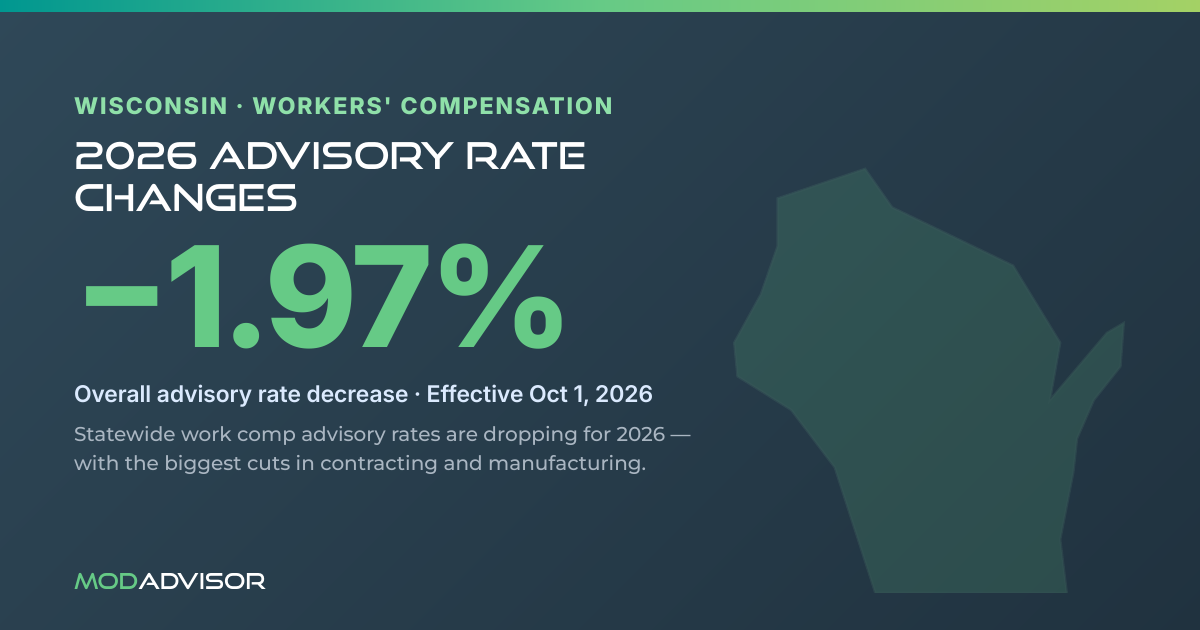
The Wisconsin Compensation Rating Bureau's new advisory rates cut the statewide rate level by nearly 2% — but the story underneath that number is a lot more interesting than the headline.
Effective October 1, 2026
Every fall, the Wisconsin Compensation Rating Bureau (WCRB) files new advisory rates, and the state's Office of the Commissioner of Insurance signs off on them. For policies effective October 1, 2026 and later, the WCRB approved an overall rate-level decrease of 1.97%.
That's good news at the surface. But "overall" hides a lot. Some businesses will see their rate drop far more than 2%, a good number will actually see an increase, and — importantly — a lower advisory rate doesn't automatically mean a lower bill. Here's how to read it.
First, what an "advisory rate" actually is
Think of the advisory rate as a starting point, not your final price. It's a dollar figure per $100 of payroll for each type of work (each "class code"). Your actual premium is that rate, adjusted by your carrier's own pricing, your experience mod, and any credits or debits your carrier applies. So when the state cuts advisory rates, it's lowering the baseline — what happens from there depends on your business.
The cut isn't spread evenly
The 1.97% is a statewide average. Broken out by industry group, the range is wide:
Contracting−4.91%
Manufacturing−2.85%
Office & Clerical−1.19%
Goods & Services−0.70%
Miscellaneous−0.50%
Contractors come out best as a group. Drill down to individual class codes and the spread is bigger still. Across the 483 classifications we compared year over year, 361 classes went down, 121 went up, and one held flat — with individual moves ranging from roughly −25% to +22%.
Averaged with every class code counted equally, the typical class fell about 2.6% (the median was −3.3%) — a bit more than the statewide 1.97%. That's not a contradiction: the state's headline figure is premium-weighted, so high-payroll classes count for more. Clerical office work (the single largest class by payroll) actually rose about 1%, which pulls the weighted statewide number up, even though most individual classes fell by more.
Notable movers
A few examples of where rates fell the most:
Athletic teams — non-contact sports−25.5%
Forged chain manufacturing−18.2%
Wood casket / coffin manufacturing−17.2%
Conduit construction (cables & wires)−17.1%
Structural iron & steel erection−14.2%
And where they climbed:
Garbage / refuse works - +21.3%
Storage battery manufacturing - +20.0%
Retail drug stores - +19.8%
Synthetic rubber manufacturing - +19.4%
Labor unions - +21.3%
The takeaway: the average is reassuring, but your own classification is what matters. A full class-by-class comparison — 2025 rate, 2026 rate, and the exact percentage change for every code — is available in the companion PDF.
Experience Rating Changes
Beyond the rates themselves, the WCRB made several structural changes that can affect your premium and your experience mod:
The split point rose from $21,500 to $24,000. The split point is the line between the "primary" and "excess" portion of each claim. Primary losses carry more weight in your experience mod. Raising the split point means more of each claim's cost lands in the primary bucket — so how you manage claims matters even more.
The experience-rating eligibility threshold dropped from $7,500 to $7,250. That's a small change with a real effect: slightly smaller employers now qualify for an experience mod, which means their own claims history — good or bad — starts driving their premium.
A few others worth knowing:
The per-claim accident limit rose from $167,500 to $187,000.
Federal ("F") classifications — longshore and harbor work — saw their premium level fall by 11.40%.
Payroll caps for owners went up: the amount used for sole proprietors, partners, and LLC members rose to $71,500, and the executive officer maximum rose to $107,276 a year.
What this means for you
A statewide rate cut is a tailwind, not a guarantee. Whether your premium actually drops depends on three things the state's number doesn't touch: your experience mod, your carrier's loss-cost multiplier and credits, and your class mix. A business in a class that fell 15% could still see its bill rise if its mod jumped — and vice versa.
The higher split point is the piece to watch most closely. It rewards employers who report injuries quickly, get people back to work, and keep small claims from turning into large ones — because more of every claim now counts where the mod is most sensitive.
Before your October renewal, it's worth confirming your class codes are right, checking how the new rates land on your specific classes, and understanding what's driving your mod. That's exactly the kind of review Mod Advisor is built for — turning changes like these into a clear picture of where your premium is headed and what you can do about it.
Source: Wisconsin Compensation Rating Bureau General Circular Letter 3273 (rates effective October 1, 2026) and Circular Letter 3264 (rates effective October 1, 2025). Advisory rates are a baseline per $100 of payroll and do not by themselves determine final premium.