West Virginia's Loss Costs Fell 1.6% for 2027. Most Class Codes Went Up.
West Virginia's Loss Costs Fell 1.6% for 2027. Most Class Codes Went Up.
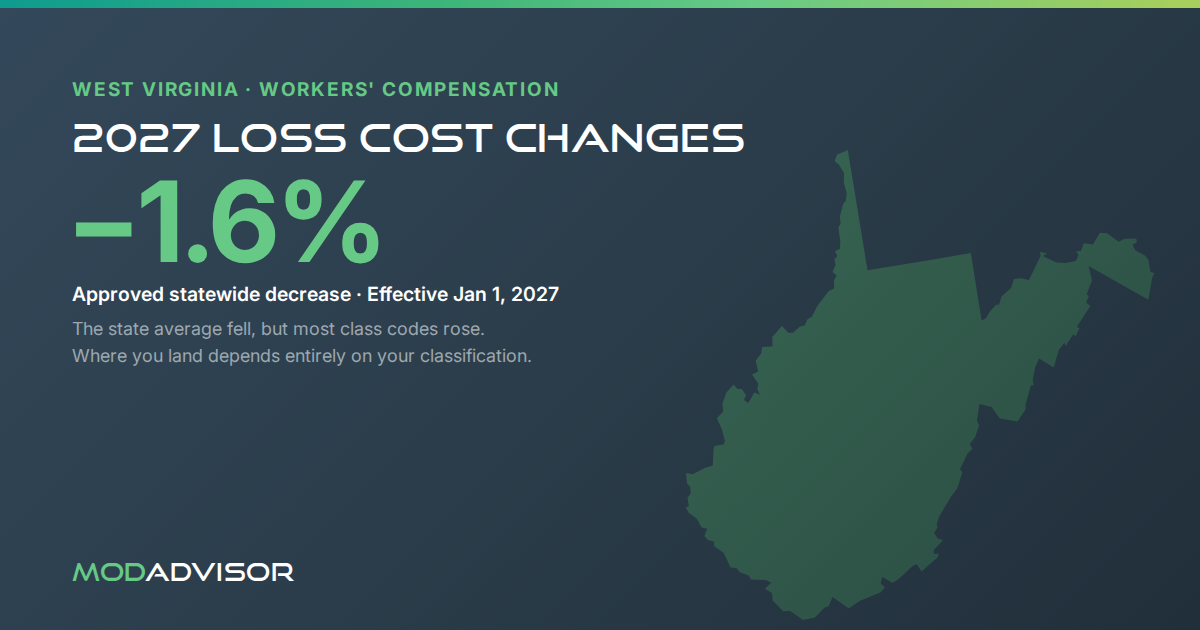
West Virginia has approved a 1.6% decrease to voluntary advisory loss costs effective January 1, 2027. But 306 of 548 classifications increased, and the typical class rose 1.6% rather than falling. Both statements are true, and the gap between them is the most useful thing in this filing.
NCCI filed its annual West Virginia loss cost and assigned risk rate recommendation on July 23, 2026, and it was approved as filed: a 1.6% decrease to voluntary-market advisory loss costs and a 0.5% decrease to assigned risk rates, both effective January 1, 2027.
Everything below describes the voluntary loss costs.
Why the headline and the table disagree
This is the year to understand what "statewide" means. NCCI's 1.6% is premium-weighted: classes carrying more payroll across the state count for more. Count every class code equally instead and the picture inverts.
Measure | Result |
|---|---|
Approved statewide change (premium-weighted) | −1.6% |
Average change per class code (unweighted) | +1.60% |
Median class change | +1.13% |
Classes with a decrease | 226 |
Classes with an increase | 306 |
Classes flat | 16 |
The state's decrease is being carried by its largest classes by payroll, while the majority of individual classifications went the other way. If you are a smaller employer in a class that is not one of West Virginia's payroll heavyweights, the odds are better than even that your loss cost rose in a year the state reported a decrease.
First: these are loss costs, not rates
An advisory loss cost is only the portion of the price meant to pay claims, with no provision for your carrier's expenses, commissions, taxes, or profit. Your carrier applies its own filed loss cost multiplier (LCM) to reach a rate, so two carriers working from the same loss cost can quote very different numbers.
What drove the filing
The filing is built on premium and loss experience as of year-end 2025 and shows improved experience relative to the prior filing. Two things about the method matter as much as the result:
The experience period was extended from three policy years to four, now covering policy years 2021 through 2024. NCCI made the change because policy year 2024 carried an unusually high loss ratio, and four years keeps a single volatile year from dominating the answer. That changes what the filing is measuring, not just what it concluded.
Indemnity loss ratio trend is up. Policy year 2024 showed a significant increase in the indemnity loss ratio, driven by both the volume and the cost of claims. NCCI notes this could be an outlier against a ten-year history. Even so, the overall trend selection remains negative, because wages are expected to grow faster than indemnity benefits.
Where the movement went by industry
Industry group | Classes | Average change |
|---|---|---|
Contracting | 76 | −2.18% |
Office & Clerical | 27 | −0.93% |
Goods & Services | 108 | −0.48% |
Miscellaneous | 86 | +1.32% |
Federal (F) classifications | 15 | +2.19% |
Manufacturing | 232 | +4.13% |
Unweighted average of the class-level changes in each group, computed by Mod Advisor from NCCI classification assignments. NCCI does not publish a group breakdown with this filing.
West Virginia manufacturers are up 4.1% on average in a year the state came down 1.6%, a swing of nearly six points against them relative to the headline. Contractors and office exposure improve. This is the clearest industry split of any state filing this cycle.
Where everyday West Virginia employers land
Code | Classification | 1-1-2026 | 1-1-2027 | Change |
|---|---|---|---|---|
5645 | Carpentry: residential dwellings | 2.424 | 2.186 | −9.82% |
5403 | Carpentry NOC | 1.064 | 1.030 | −3.20% |
9082 | Restaurant NOC | 0.300 | 0.292 | −2.67% |
9052 | Hotel: all other employees | 0.420 | 0.416 | −0.95% |
8006 | Store: convenience, retail | 0.383 | 0.380 | −0.78% |
8810 | Clerical office employees NOC | 0.045 | 0.045 | 0.00% |
7219 | Trucking NOC | 2.066 | 2.074 | +0.39% |
9014 | Janitorial services by contractors | 0.738 | 0.747 | +1.22% |
5183 | Plumbing NOC | 0.620 | 0.659 | +6.29% |
7380 | Drivers, chauffeurs and their helpers NOC | 1.075 | 1.142 | +6.23% |
8017 | Store: retail NOC | 0.337 | 0.360 | +6.82% |
8868 | School: professional employees | 0.099 | 0.106 | +7.07% |
Coal moved sharply. Surface coal mining (Code 1005) rose 12.3% from 5.298 to 5.951, and coal mining NOC (Code 1016) rose 11.5% from 17.445 to 19.457. The non-ratable disease elements attached to those classes rose with them, Code 1005 from $4.054 to $4.673 and Code 1016 from $14.844 to $17.108, a 15% increase that sits on top of the class loss cost rather than inside it.
The widest swings in the table are waterfront classes priced off national rather than West Virginia experience, and they should not be read as a signal about the state economy: Code 8726F rose 116.6% and Code 8709F rose 74.2%, while Code 7327F fell 53.3%.
The changes that are not in the loss cost table
Deductible credits get smaller. The advisory loss elimination ratios tick down at every deductible in every hazard group. A $2,500 deductible in hazard group A moves from 19.0% to 18.6%.
Owner payroll rises about 3.6%. The maximum weekly payroll for executive officers, and for athletic sports under Codes 9178 and 9179, goes from $4,400 to $4,600; the weekly minimum from $1,100 to $1,150; and the annual payroll basis for partners and sole proprietors from $57,700 to $59,800.
A few others worth knowing:
The taxicab basis of premium (Code 7370) rises to $89,800 for employee-operated vehicles and $59,800 for leased or rented vehicles.
The USL&HW coverage percentage moves from 107% to 108%, with the non-F adjustment factor going from 2.07 to 2.08.
West Virginia continues to publish non-ratable element codes for first responder PTSD coverage under Section 23-4-1f. Those codes carry published values in the assigned risk market only; a voluntary carrier intending to offer the coverage must file its own value with the Insurance Commissioner.
What this means for you
Of all the state filings this cycle, West Virginia is the one where the headline is least useful on its own. Four things decide your January renewal:
Your class codes, more than anything else. Manufacturing is up over four points while contracting is down two. The statewide decrease is not a decrease for the majority of classifications.
Your carrier's loss cost multiplier. Carriers file their own LCMs and can revise them independently of this filing.
Your experience modification factor. A mod moving from 1.05 to 0.90 is a 14% premium change on its own.
Your owner payroll and deductible. Both moved against employers outside the loss cost table.
Before your January renewal, it is worth confirming your class codes, checking how the new loss costs land on your specific classes rather than on the state as a whole, comparing your carrier's LCM against the market, and understanding what is driving your mod. Mod Advisor carries the full class-by-class comparison for all 548 West Virginia codes: the 1-1-2026 loss cost, the 1-1-2027 loss cost, and the exact percentage change, alongside your own classifications and mod.
Contains NCCI copyrighted information. Figures above are voluntary-market advisory loss costs, which cover losses only and exclude all carrier expense provisions; they do not apply to assigned risk policies and do not by themselves determine final premium. Class-level and industry-group averages computed by Mod Advisor. Prepared by Mod Advisor.