Tennessee's October 1, 2026 Work Comp Loss Costs to increase 4.8%
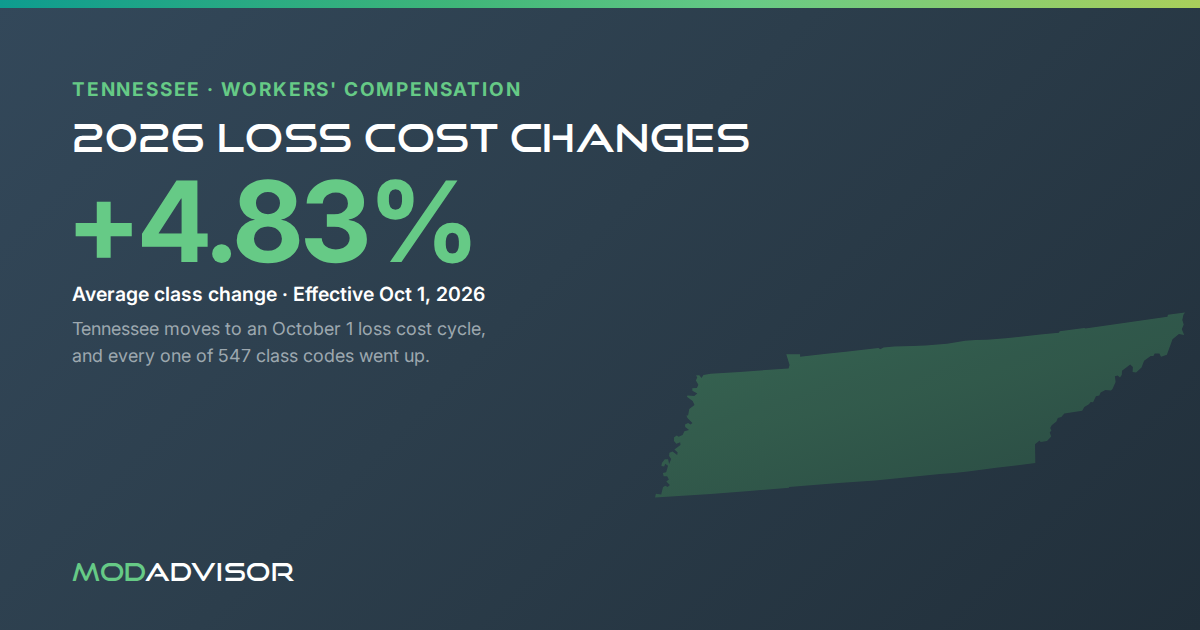
Tennessee Work Comp Loss Costs Move to October 1, and Every Class Code Went Up
NCCI's new Tennessee advisory loss costs take effect October 1, 2026, just seven months after the last set. All 547 classifications rose, by an average of 4.8%. But the experience rating values that drive your mod stay on the March 1 cycle, so your loss costs move and your mod doesn't.
NCCI has published new advisory loss costs for Tennessee effective October 1, 2026. Two things about this set are unusual, and both matter more than the percentage itself.
First, the timing. The previous published Tennessee loss costs were effective March 1, 2026, so this is a seven-month step rather than a full year of experience. Second, and more consequential: Tennessee's experience rating values are staying on the March 1 cycle. The information used to calculate an experience mod remain effective as of 3-1-2026, and the next revision to those values is 3-1-2027.
First: Tennessee publishes loss costs, not rates
An advisory loss cost is only the portion of the price meant to pay claims. It contains no provision for your carrier's expenses, commissions, taxes, or profit. Your carrier takes the loss cost and applies its own filed loss cost multiplier (LCM) to arrive at a rate. Two carriers working from the identical NCCI loss cost can quote you meaningfully different numbers.
So a 4.8% average increase in Tennessee loss costs is an increase in the raw ingredient. What lands on your renewal depends on your carrier's LCM, your mod, your class mix, and any credits or debits on your account.
How big is the increase?
NCCI has not yet published its State Advisory Forum summary for this filing, which is the only public source for the official premium-weighted statewide change. What we can do is compare the two published sets class by class.
Across the 547 Tennessee classifications carrying a published loss cost in both sets, every single one went up. The average class code rose 4.83%, the median 4.94%, and the range ran from +0.86% to +9.09%. These are unweighted averages, with every class code counted equally, so NCCI's eventual statewide figure will differ, because it weights by premium.
A useful way to read a set like this: when there are no decreases and the spread is narrow, the change is a broad level movement rather than a reshuffling among classes. Nobody in Tennessee is being singled out here. The whole table lifted.
The one group that barely moved
Grouping the 547 classifications by NCCI industry group shows how flat the increase is, with one exception:
Industry group | Classes | Average change |
|---|---|---|
Office & Clerical | 26 | +5.21% |
Goods & Services | 104 | +5.08% |
Manufacturing | 232 | +5.04% |
Contracting | 76 | +4.76% |
Miscellaneous | 88 | +4.66% |
Federal (F) classifications | 15 | +0.90% |
Unweighted average of the class-level changes in each group, computed by Mod Advisor from NCCI classification assignments. NCCI does not publish a group breakdown with this filing.
Five of the six groups land within half a point of each other, between +4.7% and +5.2%. The federal (F) classifications (shipbuilding, stevedoring, ship scaling and the rest of the waterfront classes written under the U.S. Longshore and Harbor Workers' Compensation Act) rose only 0.90%. Those classes are priced off longshore experience rather than Tennessee's, and the USL&HW coverage percentage (108%) and non-F adjustment factor (2.08) are both unchanged, so they moved on their own track.
Where everyday Tennessee employers land
Code | Classification | 3-1-2026 | 10-1-2026 | Change |
|---|---|---|---|---|
8810 | Clerical office employees NOC | 0.046 | 0.048 | +4.35% |
8742 | Salespersons or collectors: outside | 0.094 | 0.099 | +5.32% |
9082 | Restaurant NOC | 0.355 | 0.374 | +5.35% |
8017 | Store: retail NOC | 0.494 | 0.520 | +5.26% |
9052 | Hotel: all other employees | 0.506 | 0.532 | +5.14% |
9014 | Janitorial services by contractors | 0.736 | 0.772 | +4.89% |
5183 | Plumbing NOC | 1.008 | 1.056 | +4.76% |
5403 | Carpentry NOC | 1.902 | 1.995 | +4.89% |
7219 | Trucking NOC | 2.471 | 2.570 | +4.01% |
5645 | Carpentry: residential dwellings | 4.630 | 4.890 | +5.62% |
The largest increases in the table are concentrated in very low loss cost classes, where a one-thousandth rounding step is a large percentage. Code 8603 (architectural or engineering firm, clerical) moves from 0.022 to 0.024, which reads as +9.09% but is two-tenths of a cent per $100 of payroll. The largest increases in dollars are in the heavier classes: Code 9186 (carnival, circus or amusement device operator) rises from 5.173 to 5.523, and Code 7050M (sail vessels under Admiralty law) from 3.289 to 3.501.
Mod Advisor carries the full class-by-class comparison for all 547 Tennessee codes: the 3-1-2026 loss cost, the 10-1-2026 loss cost, and the exact percentage change, alongside your own classifications and mod.
What did not change
We diffed the advisory miscellaneous values page of both sets line by line. Apart from the effective date, nothing on it moved:
Officer payroll caps hold. Maximum weekly payroll stays at $5,200 for executive officers generally and $1,910 for officers in the construction industry; the minimums stay at $1,300 and $650.
The annual payroll basis for partners and sole proprietors stays at $67,400, with the construction-industry range unchanged at $33,800 to $99,100.
The taxicab basis of premium (Code 7370) holds at $101,200 for employee-operated vehicles and $67,400 for leased or rented vehicles.
Advisory terrorism (0.005) and catastrophe (0.010) loss costs are unchanged.
Loss elimination ratios are unchanged at every deductible in every hazard group, so deductible credits are the same as they were on March 1.
The coal mine disease elements hold: Code 1005 at $0.467 and Code 1016 at $1.402.
This is, in other words, a loss-cost-only revision. Everything else in the Tennessee manual is where it was.
The mod timing wrinkle, and why it matters
Because expected loss rates stay on the March 1 cycle, a Tennessee employer renewing between October 1, 2026 and February 28, 2027 gets new loss costs against old expected loss rates.
Practically, that means the mod you receive for a rating effective date in that window is computed exactly as it would have been before October 1: the 3-1-2026 ELRs and D-ratios, the same split point, the same expected losses for your payroll. Your mod does not absorb the loss cost increase, and it does not offset it. The increase passes straight through to the manual premium the mod is applied to.
Two dates to keep straight if you renew this fall:
October 1, 2026: new advisory loss costs. Your rate basis goes up.
March 1, 2027: next revision to expected loss rates and D-ratios. Your mod's yardstick changes then, not now.
One more consequence worth planning around: if the 3-1-2027 ELR revision moves expected loss rates up to catch up with the new loss cost level, mods will generally come down slightly for employers whose own losses held steady, because a higher expected loss for the same payroll makes the same actual losses look better. If ELRs hold, mods won't move on that account. Either way, the fall increase and any mod effect arrive in separate innings.
What this means for you
An across-the-board loss cost increase is a headwind, not a verdict. Three things the NCCI filing doesn't touch will decide what your renewal actually looks like:
Your carrier's loss cost multiplier. Carriers file their own LCMs and can revise them. A carrier trimming its multiplier can absorb part or all of a 5% loss cost increase before you ever see it, and one raising its multiplier will compound it.
Your experience modification factor. A mod moving from 1.10 to 0.95 more than offsets a 5% loss cost increase. Your claim experience is still the biggest lever you control.
Your class codes. A misassigned classification costs more in a rising year than a falling one. This is the cheapest thing to check and the most commonly wrong.
Before your renewal, it is worth confirming your class codes are right, checking how the new loss costs land on your specific classes, comparing your carrier's LCM against the market, and understanding exactly what is driving your mod, including which rating effective date, and therefore which set of ELRs, applies to it. That's exactly the kind of review Mod Advisor is built for: turning filings like this one into a clear picture of where your premium is headed and what you can do about it.
Contains NCCI copyrighted information. Advisory loss costs cover losses only and exclude all carrier expense provisions; they do not by themselves determine final premium. Class-level averages and industry-group averages computed by Mod Advisor from the published 3-1-2026 and 10-1-2026 advisory loss cost pages; NCCI has not published a premium-weighted statewide change for this filing. Prepared by Mod Advisor.