New York Work Comp Loss Costs Are Falling Again in 2026
New York Work Comp Loss Costs Are Falling Again in 2026 — Down Nearly 22%
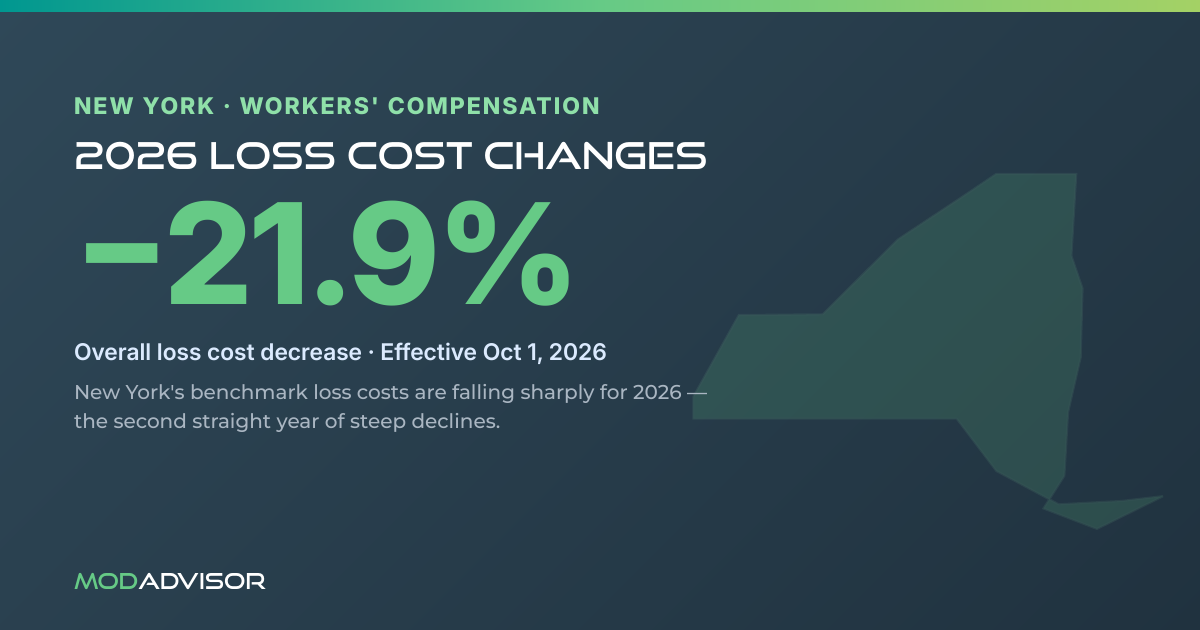
The New York Compensation Insurance Rating Board's new benchmark loss costs drop 21.9% — the second straight year of steep declines — but whether that reaches your premium depends on your carrier.
Effective October 1, 2026
Each summer the New York Compensation Insurance Rating Board (NYCIRB) files updated loss costs, and the New York State Department of Financial Services approves them. For policies effective October 1, 2026, the Department approved an overall loss-cost-level decrease of 21.9% — following a 13.2% cut the year before. Two years running, the benchmark for pricing New York work comp has fallen sharply.
That's a strong tailwind for employers. But in New York, the headline number and your actual bill aren't the same thing — and the gap is bigger here than in most states. Here's why.
First, what a "loss cost" is — and isn't
New York is a loss-cost state. NYCIRB doesn't publish the rate you pay; it publishes an advisory loss cost for each class of work — essentially the expected claim cost per $100 of payroll, before any insurer markup. Each insurance company then applies its own loss cost multiplier (LCM) to turn that loss cost into the rate it actually charges.
What this means for you: a 21.9% cut in loss costs is not an automatic 21.9% cut in your premium. If your carrier's multiplier stays the same, you'd see the benefit — but carriers can and do adjust their multipliers. The decrease only reaches you if your insurer passes it through.
The cut is nearly across the board
Across the 527 classifications we compared year over year, 520 went down, six went up, and one was flat. The typical class fell about 25% (the median was −25.9%), with most classes landing between roughly −20% and −35%.
That per-class average is a bit steeper than the statewide 21.9%, and that's expected, not a contradiction: the state's headline figure is premium-weighted, so the largest classes by payroll carry more of the math, while a simple average counts every class code equally.
Notable movers
Where loss costs fell the most:
Internet / web application development−48.3%
Clerical telecommuter employees−47.5%
Independent livery drivers−44.2%
Iron or steel erection — frame structures−39.8%
Tunneling (not pneumatic)−38.1%
And the handful that rose:
Dress pattern manufacturing — paper - +157.1%
Pottery manufacturing — china / tableware - +36.4%
Smelting — electric process - +25.6%
Pottery manufacturing — earthenware - +22.2%
The lesson is the same as always: the statewide average is reassuring, but your own classification is what matters. A full class-by-class comparison — 2025 loss cost, 2026 loss cost, and the exact percentage change for every code — is in the companion PDF.
Other things to note
The U.S. Longshore & Harbor Workers' coverage percentage was revised to 92.3%.
The terrorism ($0.029 per $100 of payroll) and natural-disaster / catastrophe ($0.003) loss cost provisions are unchanged.
Class Code 9027 moves to a payroll exposure basis on October 1, 2026 and will be discontinued after a transition period ending in 2028.
For experience-rated employers, New York's primary/excess split point is graduated by expected losses, running from $1,000 up to a $170,000 cap — the split point determines how much of each claim counts as "primary," where the experience mod is most sensitive.
The experience-rating side moved too — but less
Loss costs drive your premium; a separate set of values, the Expected Loss Rates (ELRs), drive the experience-rating side. ELRs are the benchmark a company's own claims are measured against when its experience mod is calculated. For 2026, ELRs fell too — for 477 of 541 classes — but only about 7% on average (median −9%), a much milder drop than the roughly 22% cut in premium loss costs. The practical takeaway: the mod side of the calculation shifts more modestly than premiums, so an employer's experience mod won't move as much as the headline loss cost decrease might suggest.
What this means for you
A falling benchmark is good news, but in New York it's only potential savings until your carrier's multiplier turns it into real savings. Whether your premium actually drops — and by how much — depends on three things the state's number doesn't control: your carrier's loss cost multiplier, your experience mod, and your class mix.
Before your October renewal, it's worth confirming your class codes are correct, checking how the new loss costs land on your specific classes, and — most importantly in a loss-cost state — verifying that your carrier is actually reflecting the decrease rather than absorbing it into a higher multiplier. That's exactly the kind of review Mod Advisor is built for: turning a filing like this into a clear picture of where your premium is really headed.
Source: New York Compensation Insurance Rating Board R.C. 2659 (loss costs effective October 1, 2026) and R.C. 2633 (effective October 1, 2025). NYCIRB publishes advisory loss costs, not rates; each insurer applies its own approved loss cost multiplier to set final rates. Prepared by Mod Advisor.