New Mexico's 2027 Work Comp Filing Is Nearly Flat
New Mexico's 2027 Work Comp Filing Is Nearly Flat, and That Hides a Real Reshuffle
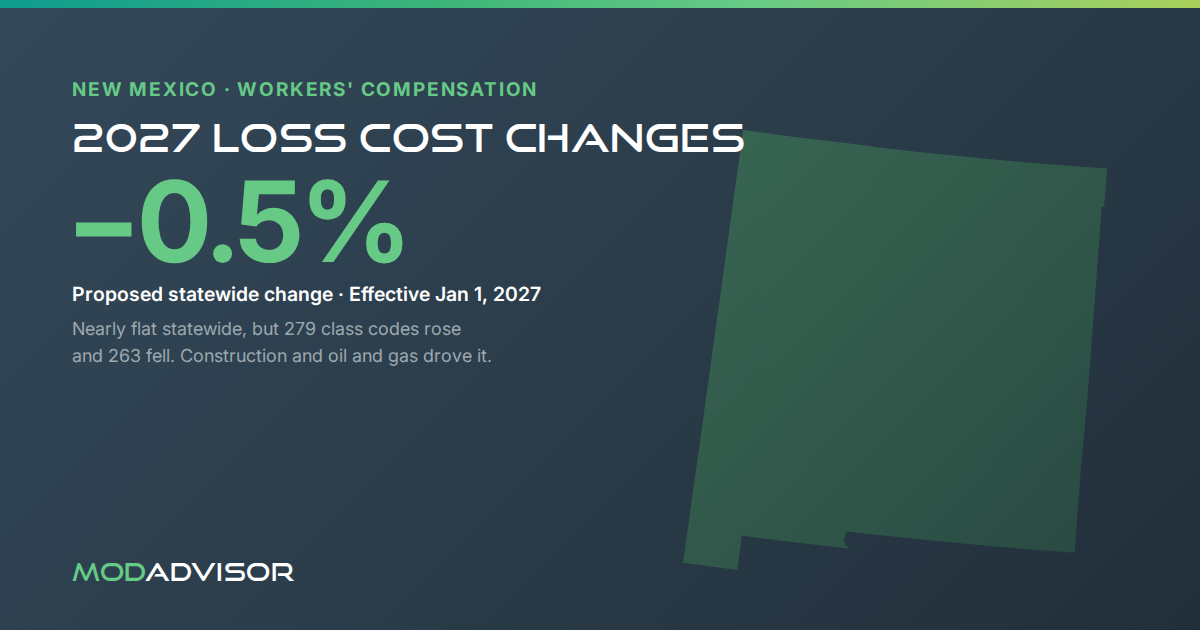
NCCI has proposed a 0.5% decrease to New Mexico's advisory loss costs for January 1, 2027. Behind that near-zero number, 279 class codes went up, 263 came down, and manufacturers and contractors moved in opposite directions.
On August 27, 2026, NCCI filed its annual New Mexico workers' compensation loss cost recommendation with the Office of Superintendent of Insurance. The proposal is a 0.5% decrease to voluntary-market advisory loss costs effective January 1, 2027.
A near-flat filing is easy to read as "nothing happened." What actually happened is that improving loss experience was almost entirely offset by rising claim costs, and the two cancelled at the statewide level without cancelling at the class level.
First: New Mexico publishes loss costs, not rates
An advisory loss cost is only the portion of the price meant to pay claims, with no carrier expenses, commissions, taxes, or profit. Your carrier applies its own filed loss cost multiplier (LCM) to reach a rate. Two New Mexico carriers working from the same NCCI loss cost can quote very different numbers.
What drove a 0.5%
The filing is built on premium and loss experience for policy years 2022, 2023 and 2024, valued at year-end 2025. Several forces pulled against each other:
Improved loss experience following the significant payroll growth and decline in claim counts that followed the pandemic.
Increased large loss activity, driven specifically by the construction and oil and gas industries, together with higher average claim costs overall, pushed system costs up in policy year 2024.
Higher ultimate loss projections. The estimated final cost of claims already incurred but not yet closed has risen, which puts upward pressure on the indication.
Where the movement actually went
Industry group | Classes | Average change |
|---|---|---|
Federal (F) classifications | 15 | −7.36% |
Contracting | 76 | −2.25% |
Office & Clerical | 26 | −1.82% |
Goods & Services | 110 | +0.66% |
Miscellaneous | 88 | +0.87% |
Manufacturing | 232 | +2.23% |
Unweighted average of the class-level changes in each group, computed by Mod Advisor from NCCI classification assignments. NCCI does not publish a group breakdown with this filing.
This is the part worth reading twice. New Mexico manufacturers are up 2.2% on average while contractors are down 2.3%, a four and a half point spread inside a filing whose headline is half a point. Across all 551 classifications the typical class rose 0.63% and the median rose 0.17%, with individual classes running from 25.6% down to 26.0% up.
Those extremes cluster tightly at roughly plus or minus 26%, which is the signature of a swing limit capping how far a single classification may move in one filing. Where a class sits on the cap, its underlying indicated change was larger than what got published, and the remainder tends to appear in a later filing.
Where everyday New Mexico employers land
Code | Classification | 1-1-2026 | 1-1-2027 | Change |
|---|---|---|---|---|
5403 | Carpentry NOC | 2.253 | 2.049 | −9.05% |
9014 | Janitorial services by contractors | 1.310 | 1.246 | −4.89% |
7219 | Trucking NOC | 3.349 | 3.212 | −4.09% |
8810 | Clerical office employees NOC | 0.084 | 0.081 | −3.57% |
9052 | Hotel: all other employees | 0.775 | 0.755 | −2.58% |
8017 | Store: retail NOC | 0.545 | 0.534 | −2.02% |
5183 | Plumbing NOC | 1.460 | 1.468 | +0.55% |
9082 | Restaurant NOC | 0.520 | 0.527 | +1.35% |
5645 | Carpentry: residential dwellings | 4.791 | 4.935 | +3.01% |
8006 | Store: convenience, retail | 0.878 | 0.920 | +4.78% |
8868 | School: professional employees | 0.224 | 0.247 | +10.27% |
7380 | Drivers, chauffeurs and their helpers NOC | 2.738 | 3.079 | +12.45% |
Note that carpentry splits: general carpentry falls 9% while residential carpentry rises 3%. Drivers rise 12.5% while trucking falls 4%. These are neighbouring classifications moving opposite ways, which is exactly why a single statewide figure cannot tell an employer what to expect.
The changes that are not in the loss cost table
Owner payroll rises about 3.9%. The maximum weekly payroll for executive officers, and for athletic sports under Codes 9178 and 9179, goes from $4,600 to $4,800. The weekly minimum goes from $1,150 to $1,200, and the annual payroll basis for partners and sole proprietors from $59,600 to $61,900.
Deductible credits get smaller. Advisory loss elimination ratios tick down at every deductible in every hazard group. A $1,000 deductible in hazard group A moves from 8.7% to 8.3%.
A few others worth knowing:
The taxicab basis of premium (Code 7370) rises to $92,800 for employee-operated vehicles and $61,900 for leased or rented vehicles.
The USL&HW coverage percentage moves from 55% to 56%, with the non-F adjustment factor going from 1.55 to 1.56.
Coal mine disease elements rise: Code 1005 from $0.487 to $0.519, and Code 1016 from $1.461 to $1.558.
What this means for you
A 0.5% statewide change is the least informative headline in this business. Four things will decide your January renewal:
Your class codes. More than in a typical year, this filing is a redistribution. Which side of it you land on depends entirely on your classifications, so it is worth confirming they are right.
Your carrier's loss cost multiplier. With the state contributing almost nothing, the carrier's multiplier is effectively the whole story on the rate side.
Your experience modification factor. A mod moving from 1.05 to 0.90 dwarfs anything in this filing.
Your owner payroll and deductible. Both moved against employers, quietly, outside the loss cost table.
Before your January renewal, it is worth confirming your class codes, checking how the new loss costs land on your specific classes rather than on the state as a whole, comparing your carrier's LCM against the market, and understanding what is driving your mod. Mod Advisor carries the full class-by-class comparison for all 551 New Mexico codes: the 1-1-2026 loss cost, the 1-1-2027 loss cost, and the exact percentage change, alongside your own classifications and mod.
Contains NCCI copyrighted information. Advisory loss costs cover losses only and exclude all carrier expense provisions; they do not by themselves determine final premium. Class-level and industry-group averages computed by Mod Advisor. Prepared by Mod Advisor.