New Hampshire Work Comp Loss Costs Fall 2.9% for 2027
New Hampshire Work Comp Loss Costs Fall 2.9% for 2027, and Assigned Risk Rates Fall Further
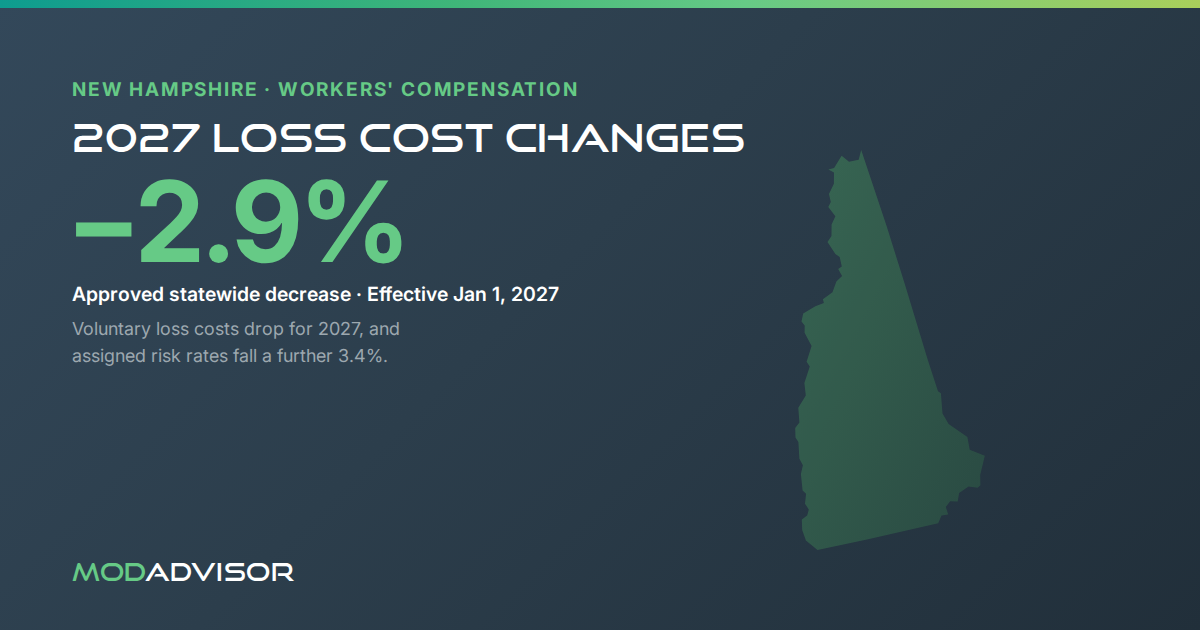
New Hampshire has approved a 2.9% decrease to voluntary-market advisory loss costs and a 3.4% decrease to assigned risk rates, both effective January 1, 2027. Underneath the statewide number, 369 of 543 classifications came down and 172 went up.
NCCI filed its annual New Hampshire workers' compensation loss cost and assigned risk rate recommendation on July 21, 2026, and it has been approved as filed. Two numbers came out of it, and which one applies to you depends on where your coverage sits:
Voluntary market: 2.9% decrease. This is the one that matters for most employers, the ones whose coverage is written by a carrier in the open market.
Assigned risk market: 3.4% decrease. This applies to employers in the residual market, the pool of last resort for risks carriers will not write voluntarily.
First: these are loss costs, not rates
An advisory loss cost is only the portion of the price meant to pay claims. It carries no provision for your carrier's expenses, commissions, taxes, or profit. Your carrier applies its own filed loss cost multiplier (LCM) to get to a rate, so two carriers working from the same NCCI loss cost can quote very different numbers.
Why loss costs are falling
The filing is built on premium and loss experience for policy years 2022, 2023 and 2024 as of year-end 2025, which shows a slight improvement over the data behind the January 1, 2026 filing. The picture is more mixed than the headline suggests:
Frequency has flattened. New Hampshire's lost-time claim frequency has levelled off after two years of significant declines. The tailwind that drove recent decreases is weaker than it was.
Indemnity severity has been volatile. The average indemnity cost per case has moved around more than usual in recent years.
Medical severity has been moderate since the large decrease in policy year 2020.
The loss cost change also includes an update to the loss-based expense component. On the assigned risk side, the rates reflect a decrease to assigned risk expenses together with an increase in the uncollectible premium provision.
The decrease is not spread evenly
Industry group | Classes | Average change |
|---|---|---|
Office & Clerical | 26 | −5.93% |
Federal (F) classifications | 15 | −5.81% |
Contracting | 76 | −3.77% |
Goods & Services | 104 | −2.66% |
Manufacturing | 232 | −1.36% |
Miscellaneous | 87 | +0.06% |
Unweighted average of the class-level changes in each group, computed by Mod Advisor from NCCI classification assignments. NCCI does not publish a group breakdown with this filing.
Office and clerical exposure gets roughly four times the relief manufacturing does, and the Miscellaneous group is flat on average, meaning a meaningful share of those classes rose. If your payroll sits mostly in that group, a 2.9% statewide decrease may not reach you at all.
Where everyday New Hampshire employers land
Code | Classification | 1-1-2026 | 1-1-2027 | Change |
|---|---|---|---|---|
5403 | Carpentry NOC | 2.885 | 2.578 | −10.64% |
7380 | Drivers, chauffeurs and their helpers NOC | 3.350 | 3.137 | −6.36% |
9052 | Hotel: all other employees | 1.192 | 1.120 | −6.04% |
8832 | Physician and clerical | 0.181 | 0.171 | −5.52% |
8810 | Clerical office employees NOC | 0.055 | 0.052 | −5.45% |
5645 | Carpentry: residential dwellings | 4.646 | 4.403 | −5.23% |
8868 | School: professional employees | 0.223 | 0.212 | −4.93% |
5183 | Plumbing NOC | 1.578 | 1.507 | −4.50% |
9082 | Restaurant NOC | 0.719 | 0.697 | −3.06% |
8017 | Store: retail NOC | 0.783 | 0.783 | 0.00% |
9014 | Janitorial services by contractors | 1.273 | 1.306 | +2.59% |
7219 | Trucking NOC | 4.031 | 4.268 | +5.88% |
Trucking is the one to flag. Code 7219 rose 5.88% in a year when the state came down 2.9%, a swing of nearly nine points against a New Hampshire fleet operator relative to the headline. Janitorial contractors also rose, and retail is flat. The statewide average is not a forecast for any individual employer.
The changes that are not in the loss cost table
Deductible credits get slightly smaller. The advisory loss elimination ratios tick down across both of New Hampshire's tables at nearly every deductible and hazard group. A $2,500 deductible in hazard group A moves from 16.4% to 16.0%. If you carry a deductible, the credit it earns you shrinks a little.
Owner payroll rises. The annual payroll basis for partners and sole proprietors goes from $40,000 to $40,300.
A few others worth knowing:
The taxicab basis of premium (Code 7370) rises to $120,800 for employee-operated vehicles and $80,500 for leased or rented vehicles.
The USL&HW coverage percentage moves from 44% to 45%, with the non-F adjustment factor going from 1.44 to 1.45.
The executive officer weekly payroll maximums and minimums, and the athletic sports maximum of $6,200, are unchanged.
What this means for you
A statewide decrease is a starting point, not an outcome. Four things will decide your January renewal:
Which market you are in. Voluntary and assigned risk moved by different amounts, and they are priced by entirely different mechanisms.
Your carrier's loss cost multiplier. With the state contributing under three points, the carrier's multiplier is the larger lever on the rate side.
Your experience modification factor. A mod moving from 1.05 to 0.90 is a 14% premium change on its own, far bigger than anything in this filing.
Your class codes. Carpentry fell more than 10% while trucking rose almost 6%. Which side you are on is decided by classification.
Before your January renewal, it is worth confirming your class codes, checking how the new loss costs land on your specific classes, comparing your carrier's LCM against the market, and understanding what is driving your mod. Mod Advisor carries the full class-by-class comparison for all 543 New Hampshire codes: the 1-1-2026 loss cost, the 1-1-2027 loss cost, and the exact percentage change, alongside your own classifications and mod.
Contains NCCI copyrighted information. Figures above are voluntary-market advisory loss costs, which cover losses only and exclude all carrier expense provisions; they do not apply to assigned risk policies and do not by themselves determine final premium. Class-level and industry-group averages computed by Mod Advisor. Prepared by Mod Advisor.