Missouri's 2027 Work Comp Loss Costs Are Approved at 0.0%
Missouri's 2027 Work Comp Loss Costs Are Approved at 0.0%, and Almost Nobody's Loss Cost Is Flat
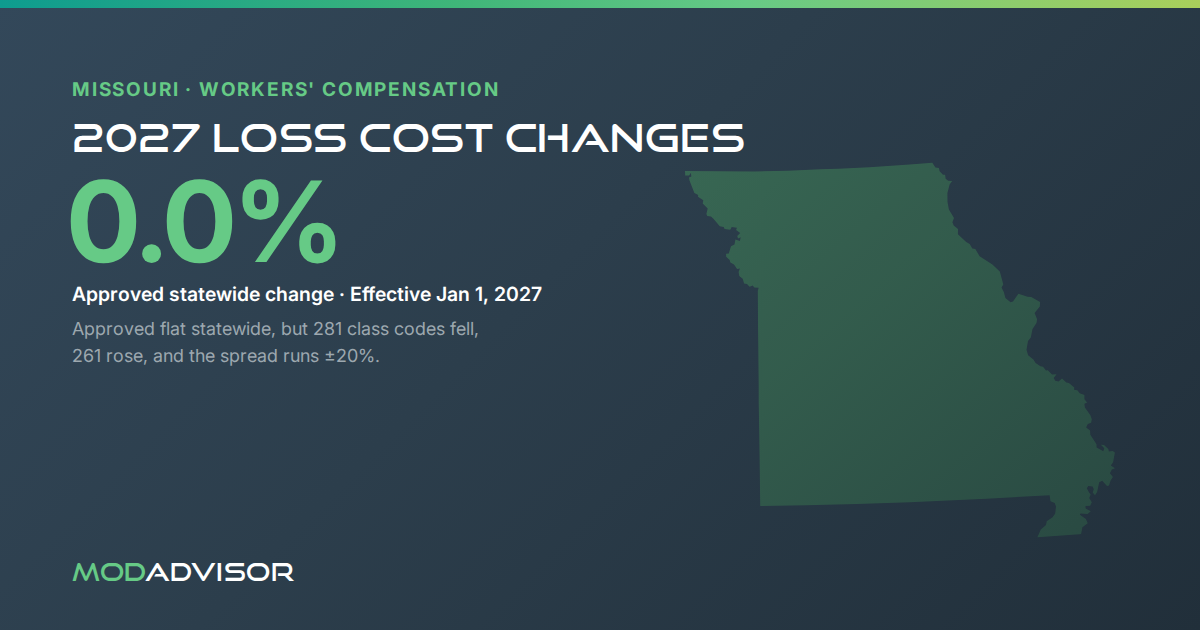
Missouri has approved no overall change to its advisory loss costs for January 1, 2027. Underneath that zero, 281 class codes fell, 261 rose, and individual classes moved as much as 21% in either direction. A statewide 0.0% tells you almost nothing about your own renewal.
On August 25, 2026, NCCI filed its annual Missouri workers' compensation loss cost recommendation with the Missouri Department of Commerce and Insurance. It has been approved as filed: a 0.0% overall change to voluntary-market advisory loss costs effective January 1, 2027.
A flat filing is rare, and it is easy to misread as "nothing happened." What actually happened is that several large forces pushed hard in opposite directions and cancelled out at the statewide level. At the class level they did not cancel out at all.
First: Missouri publishes loss costs, not rates
An advisory loss cost is only the portion of the price meant to pay claims, with no carrier expenses, commissions, taxes, or profit. Your carrier applies its own filed loss cost multiplier (LCM) to the loss cost to get a rate. Two Missouri carriers working from the same NCCI loss cost can quote very different numbers.
What drove a 0.0%
The filing is built on Missouri experience for policy years 2023 and 2024, valued at year-end 2025. Three forces, two of them pulling up:
Claim frequency kept falling. Missouri's long-term decline in claim frequency continued through the experience period, with frequency down more than 7.5% cumulatively. This is the downward force in the filing, and on its own it would have produced a decrease.
Large losses were atypical. The experience period carries more reported losses from claims above $500,000 than is normal. Policy year 2024 alone holds over $100 million in reported losses from such claims, which NCCI describes as an unprecedented amount for a year of that maturity.
Indemnity benefit payments rose. Higher indemnity payments per claim have been building for two valuations and have not abated, so NCCI increased its projection of future indemnity costs relative to the 1-1-2026 filing.
Notably, the average cost per claim in Missouri has generally tracked wage growth, so the pressure is coming from the tail of large claims and from indemnity benefit levels, not from broad-based severity inflation.
The zero is a weighted average, not a promise
Across the 547 Missouri classifications carrying a published including-trend loss cost in both years:
Measure | Result |
|---|---|
Classes with a loss cost decrease | 281 |
Classes with a loss cost increase | 261 |
Classes flat | 5 |
Average change per class code | +0.13% |
Median class change | −0.32% |
Range | −20.00% to +20.99% |
The approved 0.0% is premium-weighted, so Missouri's largest classes by payroll dominate it. Count every class code equally and the typical class barely moved, which is consistent. But the spread is the point: a Missouri employer has roughly even odds of a decrease or an increase, and the tails run out past 20% in both directions.
Where the movement went by industry
Industry group | Classes | Average change |
|---|---|---|
Contracting | 75 | −2.38% |
Office & Clerical | 27 | −1.45% |
Federal (F) classifications | 13 | −0.74% |
Goods & Services | 111 | −0.15% |
Manufacturing | 232 | +0.91% |
Miscellaneous | 85 | +1.36% |
Unweighted average of the class-level changes in each group, computed by Mod Advisor from NCCI classification assignments. NCCI does not publish a group breakdown with this filing.
Missouri contractors come out best as a group, and clerical and office classes also improve. Manufacturers and the miscellaneous group give ground. That is a real transfer inside a filing that nets to zero. A Missouri general contractor and a Missouri machine shop are looking at different years, even though the state's headline says nothing changed.
The biggest movers
Largest decreases:
Code | Classification | 1-1-2026 | 1-1-2027 | Change |
|---|---|---|---|---|
6874F | Ship scaling (coverage under U.S. Act) | 4.800 | 3.840 | −20.00% |
7327F | Stevedoring: containerized freight | 6.144 | 4.916 | −19.99% |
3122 | Razor manufacturing NOC | 1.881 | 1.524 | −18.98% |
2416 | Thread or yarn dyeing or finishing | 1.955 | 1.585 | −18.93% |
7350F | Freight handling NOC (U.S. Act) | 3.608 | 3.025 | −16.16% |
9534 | Mobile crane and hoisting service contractors | 3.035 | 2.573 | −15.22% |
Largest increases:
Code | Classification | 1-1-2026 | 1-1-2027 | Change |
|---|---|---|---|---|
7335M | Dredging, all types (Admiralty law) | 2.220 | 2.686 | +20.99% |
7333M | Dredging, all types (Admiralty law) | 1.998 | 2.417 | +20.97% |
3827 | Automobile engine manufacturing | 1.832 | 2.216 | +20.96% |
9600 | Taxidermist | 2.071 | 2.505 | +20.96% |
3385 | Watch manufacturing | 0.836 | 1.011 | +20.93% |
4351 | Photoengraving | 0.847 | 1.024 | +20.90% |
Notice how tightly those extremes cluster: the decreases stop at −20% and the increases stop just under +21%. That is the signature of a swing limit, a cap on how far any single classification is allowed to move in a single filing. Where a class is sitting on the cap, its underlying indicated change was larger than what got published, and the remainder tends to show up in the following year's filing.
For everyday Missouri employers:
Code | Classification | 1-1-2026 | 1-1-2027 | Change |
|---|---|---|---|---|
9052 | Hotel: all other employees | 1.199 | 1.124 | −6.26% |
5645 | Carpentry: residential dwellings | 5.972 | 5.600 | −6.23% |
8810 | Clerical office employees NOC | 0.085 | 0.080 | −5.88% |
8006 | Store: convenience, retail | 1.154 | 1.111 | −3.73% |
5183 | Plumbing NOC | 2.177 | 2.127 | −2.30% |
9082 | Restaurant NOC | 0.859 | 0.847 | −1.40% |
5403 | Carpentry NOC | 3.255 | 3.280 | +0.77% |
7219 | Trucking NOC | 4.762 | 4.849 | +1.83% |
8017 | Store: retail NOC | 0.988 | 1.007 | +1.92% |
9014 | Janitorial services by contractors | 1.429 | 1.477 | +3.36% |
8868 | School: professional employees | 0.312 | 0.326 | +4.49% |
The changes that aren't in the loss cost table
Several Missouri advisory values move on January 1, and one of them cuts the wrong way for employers who use deductibles:
Deductible credits get smaller. The advisory loss elimination ratios tick down at every deductible in every hazard group. A $2,500 deductible in hazard group B, for example, goes from 11.9% to 11.2%. If you carry a deductible, the credit it earns you shrinks slightly: a small premium increase hiding inside a 0.0% filing.
Owner payroll goes up. The annual payroll basis for executive officers, LLC members, partners and sole proprietors rises from $57,100 to $57,700. If you have owners on the policy, the rate may be flat while the payroll it applies to is not.
A few others worth knowing:
The taxicab basis of premium (Code 7370) rises to $96,200 for employee-operated vehicles and $64,100 for leased or rented vehicles.
The USL&HW coverage percentage moves from 81% to 82%, and the non-F adjustment factor from 1.81 to 1.82, relevant only if you write federal coverage.
Coal mine disease elements rise: Code 1005 from $0.472 to $0.502, and Code 1016 from $1.416 to $1.506.
The maximum weekly payroll for athletic sports (Codes 9178 and 9179) holds at $1,200.
Advisory terrorism (0.005) and catastrophe (0.010) loss costs are unchanged.
How Missouri fits the national picture
NCCI's countrywide numbers give the Missouri filing context. The calendar year 2025 combined ratio for workers' compensation was 91%, up from 86% in 2024. Still profitable, but less so. Voluntary market net written premium fell 1.5%. Payroll, the exposure base, grew 4.8% while employment rose only 0.5%, meaning most of the premium growth came from wages, which were up about 4.3%.
On the loss side, lost-time claim frequency fell 2% countrywide, a more moderate decline than the long-term average, while both medical and indemnity severity per lost-time claim rose about 4%. Missouri's filing is a local version of the same story: frequency improvement doing the work of holding the line against rising severity, with Missouri's own large-loss experience tipping the balance to exactly zero.
What this means for you
An approved 0.0% statewide change is the least informative headline in this business. Four things will determine your January renewal:
Your class codes. More than in a typical year, this filing is a redistribution. Which side of it you're on depends entirely on your classifications, so it's worth confirming they're right.
Your carrier's loss cost multiplier. With the state contributing nothing, the carrier's multiplier becomes the whole story on the rate side. A carrier revising its LCM will move your premium in a year when the state didn't.
Your experience modification factor. A mod moving from 1.05 to 0.90 is a 14% premium change on its own, far bigger than anything in this filing.
Your deductible credit and owner payroll. Both moved against employers here, quietly, outside the loss cost table.
Because the change is already approved, your carrier's January renewal quotes should reflect these loss costs. Before that renewal, it's worth confirming your class codes, checking how the new loss costs land on your specific classes rather than on the state as a whole, comparing your carrier's LCM against the market, and understanding what's driving your mod. That's exactly the kind of review Mod Advisor is built for: turning filings like this one into a clear picture of where your premium is headed and what you can do about it.
Contains NCCI copyrighted information. Advisory loss costs cover losses only and exclude all carrier expense provisions; they do not by themselves determine final premium. Class-level and industry-group averages computed by Mod Advisor.