Maryland Work Comp Loss Costs Are Dropping Again in 2027 — Here's What It Means for Your Premium
Maryland Work Comp Loss Costs Are Dropping Again in 2027 — Here's What It Means for Your Premium
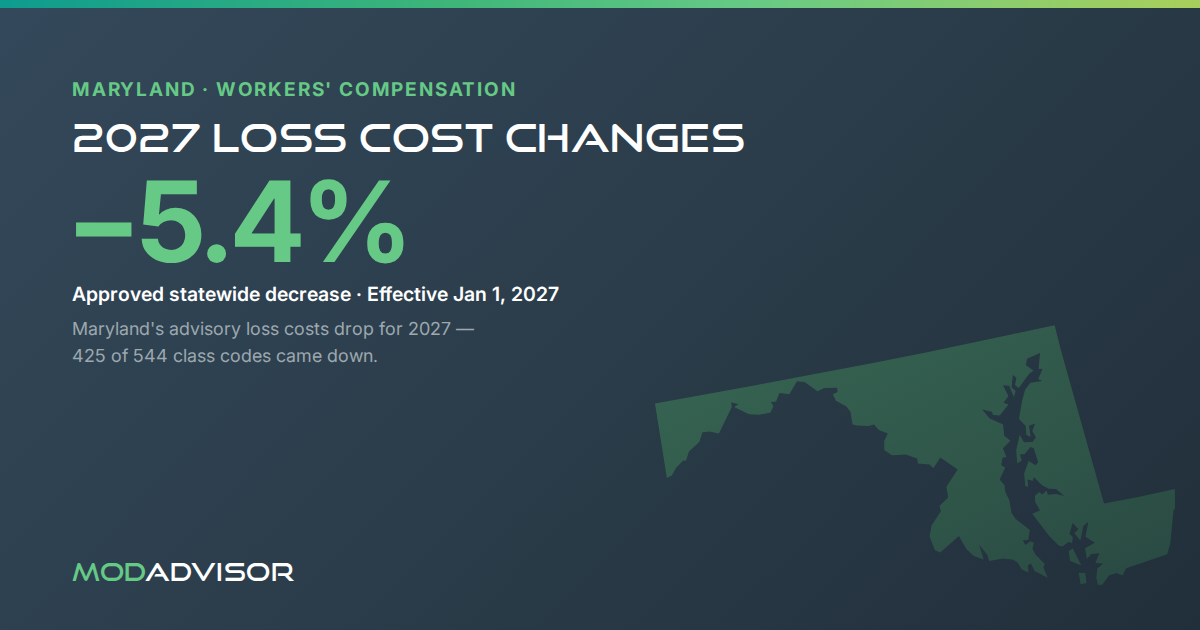
Maryland has approved a 5.4% statewide decrease in advisory loss costs. But underneath that single number, individual class codes move anywhere from down 33% to up 25%. But a lower loss cost doesn't automatically mean a lower bill.
Each year the National Council on Compensation Insurance (NCCI) files new advisory loss costs for Maryland, and the Maryland Insurance Administration reviews and approves them. For policies effective January 1, 2027, the approved advisory loss costs carry an overall decrease of 5.4% in the voluntary market, the continuation of a multi-year downward trend.
Across the 544 Maryland classifications we compared year over year, 425 went down, 113 went up, and six held flat. Here's how to read it.
First: Maryland publishes loss costs, not rates
This distinction matters more than it sounds. An advisory loss cost is only the portion of the price meant to pay claims — it contains no provision for your carrier's expenses, commissions, taxes, or profit. Your carrier takes the loss cost and multiplies it by its own filed loss cost multiplier (LCM) to get a rate. Two carriers working from the same NCCI loss cost can quote you meaningfully different numbers.
So when Maryland approves a 5.4% loss cost cut, it is lowering the raw ingredient. What lands on your renewal depends on your carrier's LCM, your experience modification factor, your class mix, and any credits or debits applied to your account.
Why loss costs are falling
The filing is built on Maryland premium and loss experience for policy years 2023 and 2024, valued at year-end 2025. Two things drove the decrease:
Lost-time claim frequency fell again. Fewer Maryland workers are missing time from work due to injury, a decline that has now run for decades, both in Maryland and countrywide.
Severity was mixed but manageable. The average indemnity cost per lost-time claim rose slightly, while the average medical cost per lost-time claim fell moderately. Together, the frequency and severity picture improved on the experience behind the 1-1-2027 filing.
Working the other direction, a recent update to Maryland's medical fee schedules adds +0.3% to the filing. NCCI made no changes to its indemnity or medical trend projections this year.
The decrease isn't spread evenly
Grouping the 544 classifications by NCCI industry group shows a wide spread:
Industry group | Classes | Average change |
|---|---|---|
Federal (F) classifications | 15 | −7.46% |
Contracting | 76 | −6.53% |
Miscellaneous | 87 | −5.06% |
Goods & Services | 104 | −4.83% |
Office & Clerical | 26 | −4.30% |
Manufacturing | 232 | −3.40% |
Unweighted average of the class-level changes in each group, computed by Mod Advisor from NCCI classification assignments. NCCI does not publish a group breakdown with this filing.
Contractors and waterfront (federal) risks come out best as groups; manufacturers give back the least. Averaged with every class counted equally, the typical Maryland class fell about 4.6%, and the median class fell 5.1%. Both sit a little under the statewide 5.4%, not a contradiction, because NCCI's headline figure is premium-weighted, so the state's largest classes by payroll carry more of the result.
Where the money actually moved
The largest decreases:
Code | Classification | Change |
|---|---|---|
6045 | Levee construction | −32.95% |
7327F | Stevedoring — containerized freight | −25.00% |
3224 | Agate or enamel ware manufacturing | −25.00% |
7225 | Automobile towing | −19.46% |
2089 | Packing house — all operations | −17.99% |
6206 | Oil or gas well — cementing | −17.84% |
And the largest increases:
Code | Classification | Change |
|---|---|---|
6826F | Marina (coverage under U.S. Act) | +24.96% |
3385 | Watch manufacturing | +20.86% |
7313F | Coal dock operation and stevedoring | +20.85% |
2417 | Cloth printing | +20.84% |
4829 | Acid manufacturing | +20.83% |
9089 | Billiard hall | +19.85% |
For a sense of where everyday Maryland employers land:
Code | Classification | Change |
|---|---|---|
5183 | Plumbing NOC | −13.29% |
9052 | Hotel — all other employees | −8.96% |
5403 | Carpentry NOC | −8.84% |
7219 | Trucking NOC | −7.73% |
8810 | Clerical office employees NOC | −6.90% |
9082 | Restaurant NOC | −4.64% |
8017 | Store — retail NOC | −4.14% |
8868 | School — professional employees | +5.83% |
The takeaway: the statewide average is reassuring, but your own classification is what actually shows up on your policy.
The changes that aren't in the loss cost table
Alongside the loss costs, several Maryland advisory values move on January 1:
Executive officer and LLC member payroll caps rise. The maximum weekly payroll used for officers and LLC members goes from $6,000 to $6,100, and the minimum from $1,500 to $1,550. The annual payroll basis for partners and sole proprietors rises from $77,600 to $79,900.
If you have owners on the policy, this alone can nudge your premium up even in a year when loss costs fall — the rate went down, but the payroll it applies to went up.
A few others worth knowing:
Deductible credits get slightly larger. The advisory loss elimination ratios tick up across every hazard group — for example, a $2,500 deductible in hazard group B moves from 10.4% to 10.7%.
The taxicab basis of premium (Code 7370) rises to $119,900 for employee-operated vehicles and $79,900 for leased or rented vehicles.
The maximum weekly payroll for athletic sports (Codes 9178 and 9179) rises from $6,000 to $6,100.
The advisory terrorism (0.040) and catastrophe (0.010) loss costs are unchanged.
Coal mining disease elements rise: Code 1005 from $0.390 to $0.416 and Code 1016 from $1.170 to $1.248.
What this means for you
A statewide loss cost decrease is a tailwind, not a guarantee. Three things the NCCI filing doesn't touch will decide whether your premium actually falls:
Your carrier's loss cost multiplier. Carriers file their own LCMs and can revise them. A carrier raising its multiplier can absorb the entire 5.4% before you ever see it.
Your experience modification factor. A mod moving from 0.95 to 1.10 swamps a 5% loss cost cut.
Your class mix. A Maryland contractor and a Maryland manufacturer are looking at very different years.
One more thing worth knowing: because the decrease is already approved, your carrier's January renewal quotes should reflect the new loss costs. If a renewal comes back flat or higher, that difference is coming from the carrier's multiplier, your mod, or your payroll — not from the state.
Before your January renewal, it's worth confirming your class codes are correct, checking how the new loss costs land on your specific classes, comparing your carrier's LCM against the market, and understanding what's driving your mod. That's exactly the kind of review Mod Advisor is built for — turning filings like this one into a clear picture of where your premium is headed and what you can do about it.
Contains NCCI copyrighted information. Advisory loss costs cover losses only and exclude all carrier expense provisions; they do not by themselves determine final premium. Industry-group averages computed by Mod Advisor.