California Work Comp Rates Rising in 2026 by 6.6%
California Work Comp Costs Are Rising for 2026 — the Advisory Benchmark Is Up 6.6%
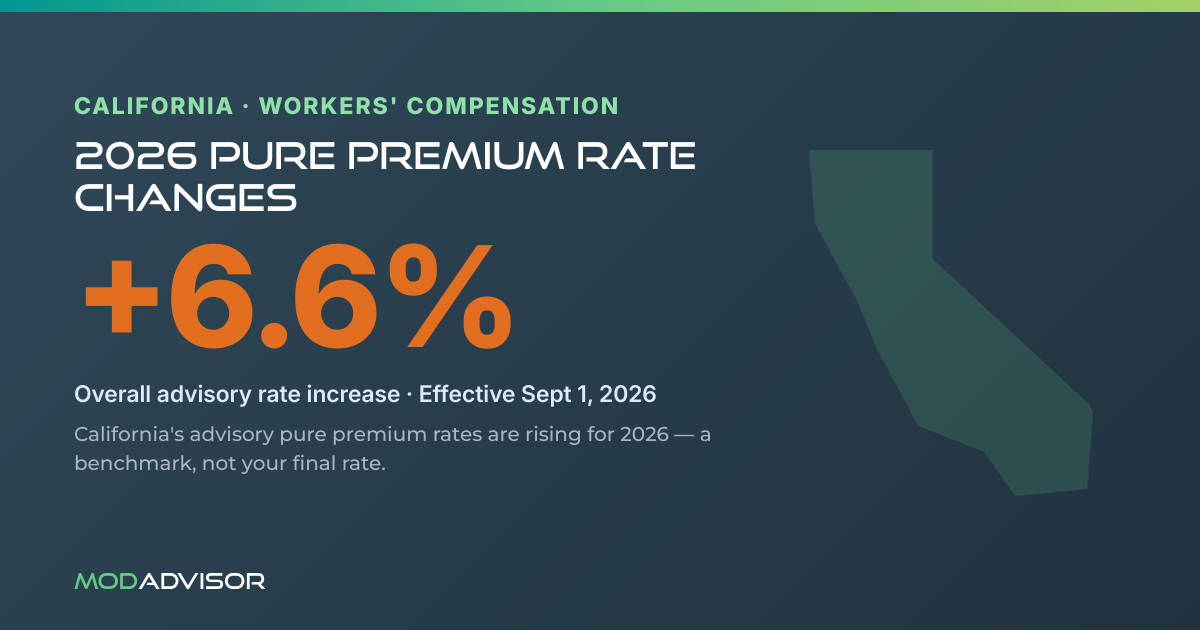
WCIRB's approved advisory pure premium rates climb 6.6% for September 2026 — the Insurance Commissioner trimmed the proposed 10.4% — but in California, that benchmark isn't your rate.
Effective September 1, 2026
Each spring the Workers' Compensation Insurance Rating Bureau of California (WCIRB) files advisory pure premium rates, and the California Insurance Commissioner decides what to approve. For policies effective September 1, 2026, the Commissioner approved rates that average $1.65 per $100 of payroll — 6.6% higher than the approved September 2025 average of $1.55. WCIRB had proposed a larger 10.4% increase; the Commissioner approved a smaller one.
After several years of declining or flat costs, this is a clear turn upward. But California works differently from most states, and the 6.6% figure needs context before anyone assumes their premium is going up by that much.
First, what a "pure premium rate" is — and isn't
California is unusual: since 2008 the state has not set or approved the rates insurers charge. Instead, WCIRB publishes an advisory pure premium rate for each class of work — essentially the expected claim cost per $100 of payroll, with no insurer expenses or profit built in. It works the same as a Loss Cost Rate that other rating bureaus use. Each insurance company then files its own rates with the Department of Insurance, using the pure premium rates as a reference point if it chooses to.
What this means for you: a 6.6% rise in the advisory benchmark is not an automatic 6.6% increase in your premium. It signals that WCIRB sees underlying claim costs trending up, which puts upward pressure on what carriers file — but your actual rate is set by your insurer, not by this number.
The increase isn't uniform
Across the 492 classifications we compared year over year, 391 rose and 101 fell. Most increases were modest — 240 classes rose between 0% and 10% — but 112 rose 10–20% and 39 climbed more than 20%. Individual moves ranged from about −20% to +65%. The all-class average change was +6.7% (median +6.1%), in line with the approved statewide figure.
Notable movers
Where the advisory rate rose the most:
Computer programming / software development - +65.0%
Auto & truck storage garages / parking lots - +33.0%
Stores — department stores - +32.8%
Apartment / condominium complex operation - +32.0%
Automobile & truck dealers - +31.8%
And where it fell:
Drug / pharmaceutical preparations mfg.−19.9%
Instrument manufacturing−16.0%
Sheet metal work−14.7%
Field crops−11.9%
Roofing−10.9%
As always, the statewide average matters less than your own classification. A full class-by-class comparison — the 2025 rate, the 2026 rate, and the exact percentage change for every code — is in the companion PDF.
What this means for you
A rising benchmark is a headwind, not a bill. Whether your premium actually goes up — and by how much — depends on three things the WCIRB number doesn't control: your insurer's filed rates, your experience modification, and your class mix. A business in a class that rose 30% could still hold its premium if its mod improved or its carrier didn't follow the benchmark up; another could see more than 6.6% if its carrier did.
Because California carriers price independently, this is the year to shop and compare. Before your renewal, it's worth confirming your class codes are correct, seeing how the new pure premium rates land on your specific classes, and understanding what's driving your mod — so a rising market doesn't quietly cost you more than it should. That's exactly the kind of review Mod Advisor is built for.
Source: WCIRB approved September 1, 2026 and September 1, 2025 advisory pure premium rates; WCIRB September 1, 2026 Pure Premium Rate Filing Decision (Bulletin 2026-11); California Workers' Compensation Uniform Statistical Reporting Plan classification phraseology. WCIRB pure premium rates are advisory only; California insurers file their own rates.